

ADHD Treatment Specialist in Belmont, NC
Attention-deficit/hyperactivity disorder (ADHD) can affect much more than the ability to sit still or concentrate. For adults, it may interfere with organization, time management, work performance, relationships, and everyday responsibilities. Symptoms often begin in childhood, but some people are not diagnosed until adulthood, when increased responsibilities make longstanding challenges more noticeable. At OptiCore Health & Wellness, Nimrode N Aridou, PMHNP-BC, MSN, BSN, RN, provides ADHD evaluation and treatment as part of the clinic’s mental health services. For more information, contact us or request an appointment online. We are conveniently located at 6640 Wilkinson blvd, suite 500, Belmont, NC 28012.


Table of Contents:
What are the common symptoms of ADHD in adults?
How is ADHD diagnosed in adults?
Can ADHD affect a person’s work and relationships?
How can I afford ADHD testing if I can’t cover the full cost upfront?
Can you use HSA funds to pay for ADHD testing and treatment in Belmont, NC?
Is ADHD hereditary?
How QbCheck supports an ADHD evaluation
What treatment options are available for adult ADHD?
ADHD treatment and patient safety
Can ADHD suddenly develop in adulthood?
What can be mistaken for ADHD in adults?
Do all adults with ADHD need medication?
Can ADHD get worse with age?
Is an online ADHD evaluation legitimate?
Does QbCheck prove that someone has ADHD?
Can untreated ADHD affect sleep?
How long does ADHD treatment last?
Personalized ADHD care and guidance at OptiCore Health & Wellness
Medical references
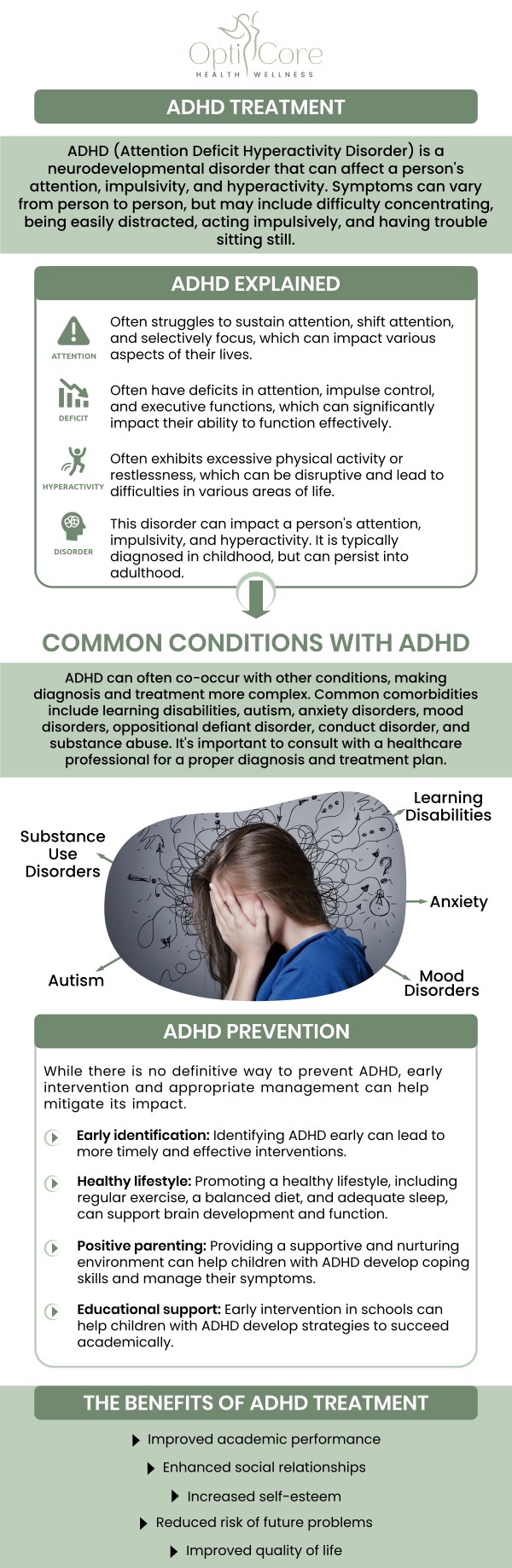
Adults with ADHD may have difficulty maintaining attention, staying organized, completing long or repetitive tasks, remembering appointments, meeting deadlines, or keeping track of important items. Some people also struggle with impulsive decisions, interrupting others, impatience, or difficulty controlling their behavior.
Hyperactivity often looks different in adults than it does in children. Instead of obvious running or climbing, an adult may feel internally restless, fidget frequently, have trouble relaxing, or feel driven to stay constantly busy. ADHD can also be associated with irritability, difficulty tolerating frustration, and frequent mood changes.
Current CDC information emphasizes that these are not necessarily “new” ADHD symptoms. Rather, established ADHD symptoms can change in appearance as a person ages. For example, hyperactivity may become less obvious physically and present more as persistent restlessness. Symptoms may also become more noticeable when work, family, financial, or organizational demands increase.
Because anxiety, depression, sleep disorders, substance use, and other conditions can cause symptoms that resemble ADHD, persistent concentration problems should be evaluated rather than assumed to be ADHD.
There is no single questionnaire, blood test, brain scan, or computerized test that can diagnose ADHD by itself.
An adult ADHD evaluation typically considers current symptoms, how long they have been present, whether symptoms appeared during childhood, and how they affect everyday functioning. A clinician may use standardized symptom questionnaires and review medical, mental health, educational, work, and family history.
For an ADHD diagnosis, symptoms must follow established diagnostic criteria, including evidence that symptoms began before age 12 and cause meaningful problems in more than one area of life. Other possible causes of attention or behavioral symptoms should also be considered.
At OptiCore Health & Wellness, ADHD evaluation options include QbCheck alongside a clinical interview. This allows objective testing information to contribute to a broader clinical assessment rather than being treated as a stand-alone diagnosis.
Yes. ADHD can affect planning, communication, time management, emotional regulation, and the ability to finish tasks.
At work, a person may miss deadlines, become distracted during meetings, struggle to prioritize projects, or have difficulty maintaining organization. Some adults perform well in highly stimulating situations but struggle significantly with paperwork, repetitive duties, or long-term projects.
In relationships, forgetfulness, impulsive comments, difficulty listening, lateness, or unfinished responsibilities can sometimes be misunderstood as a lack of interest or effort. Recognizing whether ADHD is contributing to these patterns may help patients and their clinicians identify appropriate strategies and treatment options. The CDC specifically notes that adult ADHD can cause difficulties at work, at home, and in relationships.
Cost can be an important concern when seeking an ADHD evaluation. OptiCore Health & Wellness currently operates as a cash-pay practice and lists tiered ADHD evaluation options that include QbCheck and a clinical interview. Our clinic currently lists ADHD evaluations beginning at $699, although patients should confirm current pricing when scheduling because fees and program details can change.
OptiCore also lists flexible payment options, including HSA/FSA payments and several buy-now-pay-later financing services. Patients who have out-of-network insurance benefits may also request information about the superbill provided by the clinic and discuss potential reimbursement directly with their insurer.
Financing terms, eligibility, reimbursement, and approval are determined by the individual financial provider, insurance company, or benefit plan and should not be assumed.
OptiCore Health & Wellness currently accepts HSA and FSA payments. Under IRS rules, HSA funds generally may be used for qualified medical expenses related to the diagnosis, treatment, mitigation, or prevention of disease when applicable requirements are met. That can include many legitimate mental health diagnostic and treatment expenses.
However, HSA and FSA rules vary depending on the expense and the individual plan. Patients should confirm eligibility with their HSA/FSA administrator before assuming that a particular evaluation, membership program, financing charge, or related service qualifies for tax-free reimbursement.
Genetics appear to play an important role in ADHD. The National Institute of Mental Health states that research suggests genes contribute substantially to ADHD risk, although researchers do not believe there is one single cause. Brain development, neurobiology, and environmental factors are also being studied.
This means ADHD may occur in several members of the same family, but having a parent or sibling with ADHD does not automatically mean another family member has the condition.
Family history can still be useful during an ADHD assessment. If close relatives have been diagnosed with ADHD or have experienced similar longstanding attention, organization, or impulsivity problems, sharing that information with the evaluating clinician may provide helpful context.
QbCheck is a computerized assessment that measures activity, attention, and impulse control. It uses a computer-based attention task along with webcam-based movement tracking to provide objective information related to the three core ADHD symptom areas: inattention, hyperactivity, and impulsivity.
The FDA cleared QbCheck as a prescription-use device that provides objective measurements to aid clinicians in ADHD assessment and in evaluating treatment interventions. Its results are intended to be interpreted by qualified healthcare professionals. It is therefore an assessment aid—not a test that should independently establish or rule out an ADHD diagnosis.
OptiCore Health & Wellness uses QbCheck as part of its ADHD evaluation process. The practice states that the assessment can be completed remotely using a compatible computer with a webcam and typically takes approximately 15–20 minutes. Results are then considered together with clinical information during the evaluation.
Current ADHD treatment is individualized. NIMH identifies medication, psychotherapy, and behavioral interventions as established approaches that may help reduce symptoms and improve functioning. Treatment may involve one approach or a combination depending on symptoms, medical history, coexisting conditions, personal preferences, and response to treatment.
OptiCore Health & Wellness offers medication management and telepsychiatry in addition to ADHD evaluations, and its current services also include online ADHD group support. Nimrode N Aridou, PMHNP-BC, MSN, BSN, RN, can use information from the clinical evaluation to determine appropriate next steps within the services offered.
Treatment should be monitored over time. ADHD symptoms, side effects, daily functioning, and other mental health concerns may change, so follow-up allows treatment to be adjusted when clinically appropriate.
ADHD medication is not appropriate for every patient, and medication decisions require an individualized medical and psychiatric assessment.
Prescription stimulants can be effective ADHD treatments, but the FDA requires prominent warnings about misuse, abuse, addiction, overdose, and sharing medication with others. Patients should take stimulant medication only as prescribed, keep it securely stored, and never share it with another person.
Before prescribing or continuing medication, clinicians may need to consider cardiovascular history, blood pressure and heart rate, sleep problems, substance use, other medications, pregnancy considerations, and coexisting psychiatric conditions. Certain non-stimulant medications also carry medication-specific precautions, so risks and benefits should be reviewed before treatment begins.
Patients should contact their healthcare provider if they develop troubling medication side effects, major mood or behavioral changes, worsening anxiety, significant sleep problems, or concerns about medication misuse.
Severe symptoms such as seizures, serious chest symptoms, severe confusion, hallucinations, or suspected stimulant overdose require urgent medical attention. The FDA advises seeking emergency care for serious symptoms of stimulant overdose.
Anyone experiencing suicidal thoughts or an immediate mental health crisis should call or text 988 for the Suicide & Crisis Lifeline or call 911 if there is immediate danger.
ADHD is considered a neurodevelopmental condition, so symptoms must begin during childhood even if they are not recognized or diagnosed until adulthood. Increased responsibilities may make longstanding symptoms more noticeable later in life.
Anxiety, depression, substance use, learning difficulties, and some medical or psychiatric conditions may cause problems that resemble ADHD. A thorough evaluation helps determine the most likely cause.
No. Treatment is individualized. Medication may be helpful for some patients, while psychotherapy, behavioral approaches, practical organizational strategies, or combinations of treatments may also be appropriate.
ADHD does not necessarily become progressively worse with age. Symptoms can change over time, and some may become less noticeable. However, increased work, family, financial, or organizational demands can make existing ADHD-related difficulties feel more significant.
Parts of an ADHD evaluation can be provided through telehealth when clinically appropriate, but a legitimate diagnosis still requires a clinician to evaluate symptoms, history, impairment, and alternative explanations. A computerized assessment alone should not be used to diagnose ADHD.
No. QbCheck provides objective measurements of attention, activity, and impulsivity that can support clinical assessment. FDA-cleared indications specify that the results are an aid to assessment and should be interpreted by a qualified healthcare professional.
ADHD and sleep difficulties can occur together, but sleep disorders can also cause attention and concentration problems that resemble ADHD. Sleep should therefore be considered during a thorough evaluation rather than assuming every concentration problem is caused by ADHD.
There is no single treatment duration that applies to everyone. Some adults benefit from long-term management, while treatment needs may change over time. Regular follow-up helps determine whether treatment remains effective, well tolerated, and appropriate.
ADHD can look different from one person to another, which is why evaluation should focus on the individual rather than on a checklist alone.
At OptiCore Health & Wellness, Nimrode N Aridou, PMHNP-BC, MSN, BSN, RN, provides ADHD-related mental health care supported by clinical evaluation and, when appropriate, objective QbCheck testing. Nimrode N Aridou also offers telepsychiatry and medication management, allowing eligible patients to receive ongoing mental health care through a virtual-care model.
For adults in Belmont, NC who are struggling with attention, organization, impulsivity, restlessness, or other possible ADHD symptoms, a professional evaluation can help determine whether ADHD or another condition may be contributing to those difficulties.
Patients can contact OptiCore Health & Wellness or request an appointment to learn more about ADHD testing and treatment options. We are conveniently located at 6640 Wilkinson blvd, suite 500, Belmont, NC 28012. We serve patients from Belmont NC, Cramerton NC, Mount Holly NC, Lowell NC, Gastonia NC, Stanley Dallas NC, and surrounding cities.
ADHD Full Evaluation Tiers
Ready for a full evaluation? Choose your turnaround.
All tiers include QbCheck objective testing and a clinical interview. The difference is turnaround speed and what is included afterward.
| Feature | Basic – $699 | Standard – $899 | Premium – $1,099 |
|---|---|---|---|
| Turnaround | 10 Days | 5 Days | 72 Hours |
| Testing | QbCheck + Interview | QbCheck + Interview | QbCheck + Interview |
| Medication Mgmt | Diagnosis Only | 1 Initial Consult | 1 Initial + 1 Follow-Up |
| Digital Support | Resource PDF | 1 Month FLOWN | 3 Months FLOWN |
| Group Therapy | None | 1 Month Free | 3 Months Free |
| Feature | Basic – $699 |
|---|---|
| Turnaround | 10 Days |
| Testing | QbCheck + Interview |
| Medication Mgmt | Diagnosis Only |
| Digital Support | Resource PDF |
| Group Therapy | None |
| Feature | Standard – $899 |
|---|---|
| Turnaround | 5 Days |
| Testing | QbCheck + Interview |
| Medication Mgmt | 1 Initial Consult |
| Digital Support | 1 Month FLOWN |
| Group Therapy | 1 Month Free |
| Feature | Premium – $1,099 |
|---|---|
| Turnaround | 72 Hours |
| Testing | QbCheck + Interview |
| Medication Mgmt | 1 Initial + 1 Follow-Up |
| Digital Support | 3 Months FLOWN |
| Group Therapy | 3 Months Free |
Check Out Our 5 Star Reviews


Additional Services You May Need

Additional Services You May Need
▸ ADHD Specialist
▸ Telepsychiatry
▸ Medication Management
▸ Anxiety
▸ Depression
▸ Alcohol/ Substance Use Disorder
▸ Mental Health Evaluations
▸ Psychiatric Evaluations
▸ Mobile Psychiatry
▸ Crisis Intervention
▸ Staff Consultation
▸ Anger Management
▸ Addiction
▸ Mood Disorders
▸ Insomnia
▸ Trauma
▸ PTSD


 Send Text
 How May I Help You?